Showing posts with label Audio processing. Show all posts

12/15/2009

Review of Ableton Live 6 Power!: The Comprehensive Guide (Paperback)

Though this is my first book on Live, I've combed my way through several books on computer recording in the past (Reason, Pro Tools). This book is easy to understand, well written, and concise.

After a few chapters, I'm really enjoying Live. Software that I once thought was confusing is now effortless and fun. That's the biggest compliment I can give the authors.

Product Description
Ready to unleash the awesome power of Ableton Live 6? As its name suggests, Ableton Live 6 was designed with the live performer in mind, but it goes well beyond that. You can integrate this live performance and studio software into your existing home or professional music studio to produce, compose, DJ, and much more. But how? "Ableton Live 6 Power!" is the key you need to revolutionize your studio by incorporating Live 6. Written for musicians by a fellow musician who uses Live on a daily basis, this useful guide explores fundamental and advanced Live features, and provides insider tips, tricks, and interviews with Live power users to provide you with a comprehensive overview of the ins and outs of this powerful software. Whether you are a beginner in the digital audio field or a seasoned pro, "Ableton Live 6 Power!" is the reference you need to take your music to the next level.

About the Author
John has worked in the international music industry for the past 15 years as a bassist, computer DJ, producer, remixer, researcher and writer, living and working in Tokyo, Hong Kong, and now Los Angeles. John has been performing music live with computers since 1999 and has performed techno electro jazz with his computer at numerous clubs and festivals in Asia and in U.S. Currently, John is closely involved with the underground electronic music scene in California, performing frequently at clubs, parties, and events with Live.

Click Here to see more reviews about: Ableton Live 6 Power!: The Comprehensive Guide (Paperback)

11/15/2009

Review of Working with Beats in Pro Tools: Skill Pack (Paperback)

An amazingly good book. Exactly covers what I wanted to know! The writing style is very nice and easy to read. Also very good and clear examples. Lot of good tips and hints. In one word: GREAT!

This book is on my top 10 list of best books bought ever.

Strong recommendation if you wanne learn fast about working with beats in Pro Tools!


Product Description
These days, manipulating and editing beats is one of the most important functions of a DAW, and it's one that Pro Tools excels at. Working with Beats in Pro Tools: Skill Pack teaches readers how to use the industry-leading beat manipulation tools Pro Tools software such as Beat Detective, the Beat Inspector, and Sound Replacer. It includes hands-on exercises to take readers from the novice stage to being able to perform advanced beat manipulation and editing. A key part of Working with Beats in Pro Tools: Skill Pack is the CD-ROM included with the book. It's full of sample content and examples that you will use to build a song and, in the process, learn all the beat manipulation tools of this dynamic and flexible software. Unlike other books with companion discs, the source files on every Skill Pack CD-ROM are an essential part of the book's tutorials - they are not there as mere examples, but are the building blocks from which users construct the projects. The result is a fully integrated learning experience.

About the Author
Andrew Hagerman began his musical life at the early age of eight as an aspiring tubist. Excelling at his craft, he studied at the prestigious Northwestern University in Chicago. During his time there, he also discovered a passion for position and arranging, creating works for orchestra, chamber ensemble and even jazz and rock bands. MIDI and computer music were in their infancy at this time, and Andy immediately recognized the usefulness of music technology in aiding the creative process. As a performer, he has performed in numerous ensembles of all types, and even enjoyed many years of playing at Disneyland, Walt Disney World, and Tokyo Disneyland. As a composer, he has been very active in the creation of planetarium and science center soundtracks, and his work can be heard worldwide, including at the renowned American Museum of Natural History in New York City. Presently the Associate Course Director of Advanced Audio Workstations at Full Sail Real World Education in Winter Park, Florida, Mr. Hagerman coordinates and guides the curriculum of one of the largest digital audio workstation lab environments in the world. He also remains active in composition and production with Singularity Arts, which serves the worldwide planetarium community.

Click Here to see more reviews about: Working with Beats in Pro Tools: Skill Pack (Paperback)

Review of MP3 for Dummies (Paperback)

Andy Rathbone has written a fine book for MP3 devotees, MP3 for Dummies, that provides the very basic of information that people need to get started on this fast booming craze. Rathbone offers his readers an extraordinaryamount of information that the average person on the street can make useof.

MP3 has become hot news! Websites have opened up for businessand offer the latest files, players and programs are being produced, thenumber of court cases involving copyright infringement are on the rise, onelocal university has blocked student access to one file distribution sitedue to bandwidth problems, and yes, some books have been written on thesubject.

MP3 for Dummies provides detailed information about buying,downloading, creating, sharing, and selling MP3 files. Readers will learnabout a number of places where they can buy and download MP3 files andwhere they can have customized CD's created for distribution. Readers alsohave the opportunity to create their own CD's provided that they have theright equipment to do so.

Speaking of equipment, readers will learnabout the latest and the best MP3 players and storage devices on themarket. Furthermore, they will be able to choose and use portable MP3players and learn how to hook them up to home, office, and car stereoequipment for easy listening!

Other helpful information in the bookincludes the debunking of certain MP3 copyright and piracy myths, choosingand using MP3 utilities, finding Websites that distribute MP3 files,learning how to compose your own kind of music, and a variety of tips. Theaccompanying CD contains Windows, Linux, and Mac shareware versions ofpopular MP3 players, a bunch of MP3 sample tunes, and live links toWebsites that distribute MP3 files!

The information in this book isfirst-rate! The cartoons, humor, and wit are great too! Readers will learnto experience the cool sounds of MP3 and chuckle at the same time! The bookwill also contribute to their better understanding and appreciation for Webdevelopment and computer technology. This is a great beginner book for theMP3 community!


Click Here to see more reviews about: MP3 for Dummies (Paperback)

10/26/2009

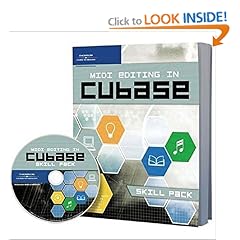
Review of MIDI Editing in Cubase: Skill Pack (Paperback)

This is a well-written and very helpful book. I am a musician of many years, however I was fairly new the world of MIDI until a few months ago. It's amazing how far it's come, and I played with it in the early days and didn't think much of it. As far as it's come, MIDI has become very sophisticated and complex. I purchased Cubase several months back, and I expected to get a handle on MIDI editing quickly. Nothing doing. What I discovered is: You can be a great musician, have spent years studying composition and arranging in a traditional sense, and none of that will necessarily help you when it comes to advanced MIDI operations and MIDI editing. Cubase has a very, very extensive and complex set of features and thoroughly understanding them is no easy task.

The Cubase manual is helpful. But, I soon discovered, it's a bit like learning to drive a car by reading the car's manual. What I realised is that I really needed a book that would walk me through various MIDI editing situations and help me get acquainted with those features in Cubase. Then, I found this book by Steve Pacey, which is exactly what I was looking for.

I just picked up the book. Having browsed through it, read the intros, and the first chapter, I can tell you it's well written. Pacey appraochs topics in a straightforward way, and his explanations are really clear. I'm going to be spending an hour or two each day to work through the book sequentially, and I think it will really pay off. If you learn best from books, then you'll really like this book. If you're taking a course in a similar topic, then I imagine this book will probably help you a lot, too. Unfortunately, music technology was nothing like it is today back when I was in school.

MIDI editing is a fairly advanced topic in my mind, and this book goes into depth. You should be generally familiar with Cubase, and you should have a reasonably good knowledge of music fundamentals. (Not to scare people away, just that if you don't know what time signatures are, for example, you might have trouble in the Quanitizing section of the book.) In this book, Pacey also covers related topics, such as score editing. He doesn't go into depth---which makes sense becuase it's a topic worthy of its own book---but, he does tie those other features of Cubase to the MIDI editing, which really helps to round out the instruction.

On a technical note, the book is written with reference to the PC version of Cubase 4. If you're using the Mac version of Cubase 4, you'll probably notice some superficial differences with the book. If you're using a previous version of Cubase, such as SX3 (which I am using on a PC), then 95% of the book will still apply to your version. (You could probably use the OEM "LE" version of Cubase and still find this book helpful.) Have the Cubase manual handy while you're working with this book so that you can cross-reference (which is something the author recommends anayway). The included CD has demo files which are specific to Cubase 4. You can't use them with a previous version of Cubase, but not a big deal---you can still work along using your own MIDI file. I'm not saying there's no value to the included demo files, just that you can easily get along without them, if need be. Don't hesitate buying this book if you're just worried that you don't have Cubase 4.

I am surprised that a book devoted to MIDI editing in Cubase hasn't come out until now. Thank you to Pacey and editors for recognising that gap.

A Table of Contents is published at the Thomson Course Technology website. I am copying it here for reference. I hope that is permissible:

Table of Contents
A Quick Look at the Key Editor
The Tool Buttons
The Toolbar
The Controller Lanes and the Line Tool
The MIDI Menu
Working with MIDI in the Project Window
The In-Place Editor and the Edit Menu
A Closer Look at Quantizing MIDI
Working with MIDI Effects and Modifiers
The Drum Editor
The List Editor, Logical Editor, and Project Browser
The Score Editor
Now That You Know Everything There Is to Know about Editing MIDI in Cubase
Working with Multiple MIDI Tracks in an Editor
More Shortcuts
Index

Product Description
MIDI editing might seem one of the most complicated tasks of any DAW, but it's one of the most important. It's also a function that Cubase® is particularly well suited to handling. Intended for those who use Cubase but want to better understand its immense MIDI editing capabilities, as well as those new to Cubase and MIDI in general, this Skill Pack will show you how to edit MIDI in every possible way using Cubase. It covers MIDI notes and events, using MIDI effects, creating a MIDI score, quantizing MIDI, and how to export your MIDI as digital audio and as a MIDI file.The Skill Pack series provides a unique book/CD-ROM learning experience that helps readers focus on a specific skill they want to learn. Unlike other books with companion discs, the source files on your Skill Pack CD-ROM are an essential part of the book's tutorials. You'll learn by applying the skills you've been taught through hands-on exercises that will take you from the novice stage to a true expert. By the conclusion of the book, you'll have a comprehensive understanding of the design and philosophy behind MIDI editing in Cubase, you'll be able to work more efficiently, and you'll know how to avoid the most common mistakes.

About the Author
Steve Pacey has held an interest in music since he was a child. His desire to learn more about music took him from piano lessons, to playing trombone in the grade-school band, to writing songs, to rapping and learning how to beat box, to playing keyboards and singing in a rock band, to attending a specialized music school, to owning and working in recording studios, to writing music for theater, TV, video, and film, to producing bands, to editing music-technology books, and writing this book. He has been a devoted Cubase user since 1990 and is currently writing and producing music for several TV shows, including the television series The Ultimate Blackjack Tour on CBS. He's a member of ASCAP, NSAI, and owns his own music-publishing company (Spot On Music) and recording studio. Pacey lives in Nashville, TN.

Click Here to see more reviews about: MIDI Editing in Cubase: Skill Pack (Paperback)