Showing posts with label Business / Economics / Finance. Show all posts

2/07/2010

Review of Sales Proposals Kit for Dummies (Paperback)

Sales Proposals Kit for Dummies is not only effective, it is an excellent read.So many books on sales techniques are so dry and virtually unreadable, but Mr. Kantin's witty style and real world examples of proposal design have had an impact on the quality of my proposals and my philosophy of sales in general.I found the proposal RATER particularly useful, as it pinpointed the areas that I needed too focus on in my proposals.My only regret is that Mr. Kantin did not write this book three

years ago. It would have saved me a lot of pain and rejection.Since I've read the book, only a few weeks ago, I'm three for three.This book is a must read for anybody who writes more than the occasional proposal.

Product Description
Sales Proposals Kit For Dummies is a unique and valuable reference that helps sales professionals create winning sales proposals that close the deal -- in simple, step-by-step terms and with real-life examples.

This friendly kit explains in clear language and simple steps how to integrate the sales and proposal processes. It provides a proven structure and guidelines for writing winning proposals. And it includes a tool for evaluating proposal quality from the buyer's viewpoint. Plus, you'll find examples of proposals in several different sectors.

From the Back Cover
"Will increase your chances of winning the 'big one.'" Bob Heckman, CEO, Navigate Consulting "Full of tips, tricks, and tools every sales pro must have!" Bill Byron Concevitch, Sr. VP, Mentergy, Inc.

Includes step-by-step instructions to help you write winning sales proposals!

Salespeople - listen up! Want a surefire way to write winning sales proposals that'll wake 'em up, seal the deal, and keep 'em comin' back for more? Let expert Bob Kantin share his savvy advice on everything from getting into your buyer's head to actually presenting a fabulous proposal. You'll come out a winner every time! all this on the CD-ROM Valuable forms and materials, including: A great tool to rate your proposal A proposal model Sample product proposals Sample service proposals A customer questionnaire System requirements: PC running Windows 95 or later, Windows NT 4 or later; Power Macintosh running System 7.6 or later. See the About the CD Appendix for details and complete system requirements.

Click Here to see more reviews about: Sales Proposals Kit for Dummies (Paperback)

2/05/2010

Review of Introduction to Accounting: An Integrated Approach (Hardcover)

Ainsworth & Deines make this topic of accounting relevant with real world examples using Apple Computers actual Financial Statements.Challenging material but very thorough and insightful. Both financial and managerial accounting is discussed throughout the textbook.Highly recommended for academic study.

Product Description
This textbook integrates financial and managerial accounting as opposed to keeping these areas separate, which is done in most books and curriculum. By using the term "integration," the authors focus on the business event and examine that event from both an external financial reporting perspective and an internal management decision-making perspective. The text incorporates real-world applications, including actual financial statements, to reinforce the relevance of topics to real business situations and promote student interest. The text also promotes active learning through "Pause & Reflect" probing questions placed sporadically throughout each chapter, "Of Interest" boxes that provide additional information relating to the chapter concepts, and end-of-chapter group exercises.There are three key distinctions to the Ainsworth/Deines/Plumlee/Larson approach. They are:1. Integration of financial and managerial concepts2. Within the context of business events, ADPL is organized by planning for events; performing those events (in other words, capturing them in the financial statements; and evaluating those business events.3. An organization around the Statement of Cash Flows, first focusing on Operating Activities (what is my business, my product, who are my customers in Volume 1 and then Financing and Investing Activities (how do I fund my business, how do I expand, what are the financial risks, etc. in Volume 2.--This text refers to an out of print or unavailable edition of this title.

Click Here to see more reviews about: Introduction to Accounting: An Integrated Approach (Hardcover)

2/04/2010

Review of Customers Rule! Why the E-Commerce Honeymoon is over and where Winning Businesses Go From Here (Hardcover)

The title, though provocative and tantalizing, is accurate.Authors Blackwell and Stephan are unabashed celebrities of the art and science of consumer behavior.It is no surprise whatsoever that the arguments and conclusions in the book are academically sound, intuitively resonant and empirically valid. It is no coincidence, either, that the style is personal, engaging and authoritative without being authoritarian. The resarch shows; practical current examples are used to cut through media hype and Wall Street analysts' obsession with trendy, flashy technology. Jump on the train, they say: the next e-business train leaving the station- all of them will take you to profits and increased market caps. WRONG!The book asks the difficult questions: Does the e-business integrate with the bricks and mortar reality of creating value for the customer? Does it make for a delightful experience? Does it make the customer want to keep coming back again and again? All this is necessary, but not sufficient. Does your e-business strategy create profit? Can this profit stream be sustained? Does it complement your current channels of supply chain management and does it lead you towards trhe new world of demand chain management? Does your strategy differentiate you from your competition? Can you sustain your advantage? The authors are technology savvy, but not mesmerized by it. The book offers insights into what strategies will work and which ones will fail and why.I recommend this book to MBA students everywhere. It is a survival handbook. Business persons will find the book practical and relevant.It will save them a lot of grief. The authors have their feet planted firmly in reality. They remind us: " e-business is no substitute for knowing what works in business and why." I learnt from this book and am giving copies to my colleague business profesors.


Click Here to see more reviews about: Customers Rule! Why the E-Commerce Honeymoon is over and where Winning Businesses Go From Here (Hardcover)

1/26/2010

Review of Sales Encyclopedia (Hardcover)

Reviewed by Irene Watson for Reader Views (11/09)

At first sight of this book I held my breath because of the 708 pages; however, once I started getting into the "meat" of the contents, I realized the value of every page. The authors are upfront in the beginning of the book by stating:If you study this book, master its principles, and apply what you've learned, you will find yourself at the very top of the selling profession...."And, I can't disagree with them.As I explored "Sales Encyclopedia," I realized this is not something I could skim through to get the full effect, but it is a book to read, read again, and implement as I go along in the second reading.

Interestingly enough, Chapin et al start off with distinguishing the difference between success and failure in selling. The reader, and prospective top salesperson, needs to be aware of this difference and the components of each.What one may think is success another may think of it as a failure.However, the authors make it very clear in setting apart the top salespeople from the mediocre and poor ones. But, they also make it very clear on how the mediocre and poor ones become top ones. The first chapter delves right into having a positive attitude - enthusiasm, drive, competitiveness, and confidence.If one doesn't have these characteristics there is no point continuing with a career as a top salesperson or any further in this book.

But, it's not only about attitude.According to the authors, a dedicated salesperson using the techniques set out in "Sales Encyclopedia" will systematically create a navigational structure to not only take themselves, but the company they own or work for far beyond any competitor.

Well written, well defined, and certainly well presented, "Sales Encyclopedia" is a book that can be used for all sales training seminars in companies, as well as mandatory reading for all inspiring salespeople, regardless of industry. Seasoned salespeople will also find confirmation of what they know already, but they will also find inspiration to make changes and look at their career with different eyes. Success only comes with the will to achieve it.Sales success comes with knowing the how and "Sales Encyclopedia" teaches the how.


Product Description
For 100 years or more, the best salespeople have been slowly developing and cataloging best practices for their own use. Nowhere has all of this information been assembled at once until now. With the publication of Sales Encyclopedia, salespeople and sales managers have a single-volume source for information on every facet of the sales process. In 47 chapters and 678 pages, six authors with a combined 143 years of sales experience guide both new and experienced sales staff through every step of selling. In a clear, easy-to-digest style, the six authors provide a comprehensive guide that will enable new salespeople to gain the equivalent of years of experience, and remind veteran sellers of why their game stays sharp.

About the Author
The authors of Sales Encyclopedia are among the most highly skilled and experienced salespeople around with a combined 143 years of real-world sales acheivement. Their vast selling experience spans many industries, and they have been at the top in each industry in which they have sold. They have extensive selling experience in face-to-face and telemarketing sales. They have sold products and services to large corporations as well as individuals, in good economic times and bad. They also have mentored new salespeople and done one-on-one and group sales training for some of the largest companies around the world.

Click Here to see more reviews about: Sales Encyclopedia (Hardcover)

Review of Instant Trainer (Paperback)

The first time someone has to train coworkers, there are lots of questions about how to do it."How should I handle stage fright?""How can I jazz up a dry topic?""If only there were an advice columnist who could help me out."With this book, there areadvice columnists for new trainers:Leslie Charles and ChrisClarke-Epstein.

Part I, only 35 pages long, is titled "What EveryFirst-Time Trainer Needs to Know (Critical Factors That Can Make or BreakYou!)."This section is a crash course on how adults learn.

PartII, titled "Questions and Answers on Training Basics," is 186pages of pure experience-sharing.The question/answer format makes foreasy reading--the questions are a paragraph long, and the answers areconcise but information-packed.This format has another advantage:when anew trainer wants information on a specific subject ("Is there somestrategy for using humour in training?"), he or she need only read oneor two pages on that specific question, then get on with the job ofpreparing for the training.The well-done index makes it simple to findthe topics quickly.

The appendices are a gold mine for someone new totraining. They include resource lists andcontact information, an excellent bibliography, and even sample evaluationforms.

This book is usable, readable, and the content is dead-on.Whennon-trainers or new trainers ask me for a resource, this is the first bookI suggest.

Product Description
HereOs the first book to show todayOs first-time trainers how to prepare, deliver, evaluate, and fine-tune presentations that will keep trainees riveted and leave them smarter and more capable. Designed to transform readers into skilled instructors in as little time as possible, no matter what size group or what kind of subject matter they address, it combines the coauthorsO 35 years of training experience. Highlighted by a casual and informative question-and-answer format, The Instant Trainer offers a bounty of practical, easy-to-absorb tips, techniques, and strategies that help novice trainers deal with an extraordinary range of issues N from overcoming stage fright to energizing apathetic audiences to reaching diverse group members. Featuring checklists, sample forms, and lists of essential training resources, The Instant Trainer is so complete it even provides a coauthor hotline if readers have specific questions that are not answered in the book! Thorough, quick, and easy to read, this book is a rich resource of ideas, techniques, and practical tips on how to teach others what you know.

From the Back Cover
"Since youOre so good at this, I want you to put on a series of training sessions to teach the others!" You can panic when you hear this from the boss, or you can grab The Instant Trainer . Designed to transform you into a skilled instructor in as little time as possible, no matter what size group or what kind of subject matter you cover, this savvy guide is a rich resource of ideas, techniques, and practical tips on how to teach others what you know. Written by two seasoned trainers and facilitators who love their craft and share their enthusiasm, The Instant Trainer will teach you how to prepare, deliver, evaluate, and fine-tune presentations that keep trainees riveted and leave them smarter and more capable. The book will help you deal with a staggering range of issues facing the first-time trainer, including: How do I overcome stage fright? How do I break the ice? What support materials work best? How do I get shy people to participate? How can I use todayOs technologies?What if my trainees are apathetic? When do I use humor?How do I reach diverse group members? And many more!Featuring checklists, sample forms, and lists of essential training resources, The Instant Trainer is so complete it even provides a co-author hotline if you have a question thatOs not answered in the book! Whether you are a new trainer or an in-house topic expert who is unexpectedly "invited" to share your knowledge and expertise, this book is the perfect short course on classroom skills.

Click Here to see more reviews about: Instant Trainer (Paperback)

1/24/2010

Review of Fundamentals of Advanced Accounting (Hardcover)

The course topics are very useful for undergraduates and a good introduction to Corporate Finance and Accounting.

However, I would recommend the latter Chapters i.e. 9,10 and 11,12 be placed in other books to allow more emphasis on the earlier chapters. This probably will make the book also good for graduate courses/students especially now with the 150 credit hour accounting programs.

Other than that, its a well developed book!!!

Product Description
Fundamentals of Advanced Accounting, 2/e is ideal for those schools wanting to cover 12 chapters in their advanced accounting course. Typically, this course covers 5-6 consolidations chapters, two foreign currency chapters, two partnership chapters, and 2-3 governmental and not-for-profit chapters. Fundamentals of Advanced Accounting boasts the same great assets that have made the authors' longer Advanced Accounting a success, including the incorporation of the latest FASB pronouncements, the integration of skill preparation for the new CPA exam, and of course, great authorship.--This text refers to the Hardcover edition.

About the Author
Joe B. Hoyle is Associate Professor of Accounting at the Robins School of Business at the University of Richmond, where he teaches Intermediate Accounting I and II and Advanced Accounting. He is currently the David Meade White Distinguished Teaching Fellow. He has been named a Distinguished Educator five times and Professor of the Year on two occasions. He is also author of Fast Track CPA Examination Review and coauthor of The Lakeside Company Case Studies in Auditing.

Thomas F. Schaefer is the KPMG Professor of Accounting at the University of Notre Dame. He has written a number of articles in scholarly journals such as The Accounting Review, Journal of Accounting Research, Journal of Accounting & Economics, Accounting Horizons, and others. His primary teaching and research interests are in financial accounting and reporting. Tom is active with the International Association for the Advancement of Collegiate Schools of Business (AACSB) and is a past President of the American Accounting Association's Accounting Program Leadership Group (APLG).

Timothy S. Doupnik is the Cramer Fellow in International Accounting at the University of South Carolina. He received his Ph.D. in Accounting from the University of Illinois. Tim is a past president of the International Accounting Section of the American Accounting Association. He currently serves as an associate editor for the Journal of International Accounting Research and on the editorial board of several other international journals.--This text refers to the Hardcover edition.

Click Here to see more reviews about: Fundamentals of Advanced Accounting (Hardcover)

1/22/2010

Review of Modeling Derivatives in C++ (Wiley Finance) (Paperback)

Like some other reviews (some of which have been removed by Amazon) have pointed out, this book is comprehensive, covers most of the right topics yet have some major flaws that prevent it from being truly useful to the students of financial engineering. It successfully COMPILES and DOCUMENTS the derivatives models in C++ but it is less sucessful in TEACHING the process of building these C++ modules. I look forward to a 2nd edition.

The author makes an honest attempt to show the mathematical and financial theories underpining the models and present the associated C++ code. However, the models and the associate codes are presented in a encyclopedia-like fashion. Moreover the codes are 'borrowed' from various sources, including the open source quantlib project, thus there's a lack of consistency. From page to page, you are directed to codes with very different coding styles. Therefore there's disjointed feel to this book.

What I would like to see a its 2nd edition are the following:
1. Relegate the code snippets to the appendix section (or just put them in the CD) and present only the neccesary codes next to the models.
2. Write his own codes or just adopt quantlib's library directly and change the title to Derivatives C++ 2nd edition: a quantlib approach. Consistency in the coding is important.
3. Decide what's the target audience of the book and what is the main object of this book? is it to teach people 'HOW' to map derivatives models to C++, is it to document 'WHAT' derivatives models and the associated C++ codes are out there.

Overall this book is promising, is ambitious in its coverage, but would benefit from a major revision. For its efforts and intentions, I would rate is 3 stars.

An alternative way (IMHO a much better way) to learn Derivatives C++ programming is to take a bottom up approach and learn the various components separately:

Mathematical Finance: Hull (2005, comprehensive coverage of derivatives models); Wilmott/Howison/Dewynne (1995, The mathematics of financial derivatives); Joshi (2005, The Concepts and practice of mathematical finance)

Mapping of mathematical models to computer programs (pseudocodes): Clewlow/Strickland (1998), Lyuu (2001), Seydel (2003)

Programming in C++: any introductory book in C++ would do (I like Deitel & Deitel); Object-oriented C++ and STL

Also need to learn the linear algebra and how to manipulate matrices and system of linear equations in C++.


Product Description
This book is the definitive and most comprehensive guide to modeling derivatives in C++ today. Providing readers with not only the theory and math behind the models, as well as the fundamental concepts of financial engineering, but also actual robust object-oriented C++ code, this is a practical introduction to the most important derivative models used in practice today, including equity (standard and exotics including barrier, lookback, and Asian) and fixed income (bonds, caps, swaptions, swaps, credit) derivatives. The book provides complete C++ implementations for many of the most important derivatives and interest rate pricing models used on Wall Street including Hull-White, BDT, CIR, HJM, and LIBOR Market Model. London illustrates the practical and efficient implementations of these models in real-world situations and discusses the mathematical underpinnings and derivation of the models in a detailed yet accessible manner illustrated by many examples with numerical data as well as real market data. A companion CD contains quantitative libraries, tools, applications, and resources that will be of value to those doing quantitative programming and analysis in C++. Filled with practical advice and helpful tools, Modeling Derivatives in C++ will help readers succeed in understanding and implementing C++ when modeling all types of derivatives.

About the Author
Justin London is the founder and visionary of GlobalMaxTrading.com (GMT), The World's Online Financial Supermarket®, a global online trading and financial technology company, as well as GlobalMaxAuctions.com, The World's Online Trading Exchange ®, a global B2C and B2B auction and trading company. He has analyzed and managed bank corporate loan portfolios using credit derivatives in the Asset Portfolio Management Group of a large bank in Chicago, Illinois. He has developed fixed-income and equity models for trading companies and his own quantitative consulting firm. London has written code and algorithms in C++ to price and hedge various equity and fixed-income derivatives with a focus on building interest rate models. A graduate of the University of Michigan, London has five degrees, including a BA in economics and mathematics, an MA in applied economics, and an MS in financial engineering, computer science, and mathematics, respectively.

Click Here to see more reviews about: Modeling Derivatives in C++ (Wiley Finance) (Paperback)

1/19/2010

Review of Profits with Principles (Hardcover)

Corporate social responsibility (CSR)-how well businesses behave in the marketplace as citizens and what they contribute, beyond how they actually run their businesses-has been on the corporate agenda for several decades, and served as a proactive way for corporations to demonstrate core `values' beyond the profit incentive. Some companies, such banking institutions, came to table reluctantly, and only after being coerced by the 1977 Community Reinvestment Act, which mandated that banks increase lending broadly in inner-city (and often impoverished) communities where they did business. Other international companies, such as Anita Ruddick's worldwide chain, The Body Shop, took it upon themselves to aggressively do business in a principled, values-defined way.

Not all corporations were so inspired, of course, to do good; and most businesses viewed CSR as being limited to charitable donations and philanthropy, not to a systemic and strategic choice for embracing social values to create core value for stakeholders. In the late 1990s, when American saw their financial wealth increase by $3 trillion a year for the years 1998-2000, at a time when the Dow had rocketed to the11,000 level, stakeholders were less concerned with how well the corporation was doing for society.

But those days are over, at least for the foreseeable future, and businesses now must react to public demands for better governance, transparency, and accountability. They have to do this on their own, building trust from stakeholders, enlarging their reach to fuel economic growth, tapping their `distinctive competencies' to harness innovation for public good, and do so while adding real value (in the form of profits) while they create values, grow stock price, improve employee satisfaction, and enhance their global brands as a fundamental part of doing business.

A new approach for helping corporations to achieve that ambitious task is Profits With Principles: Seven Strategies for Delivering Value With Values, by Ira A. Jackson and Jane Nelson, both fellows at Harvard's Kennedy School of Government, a book that uses case studies of companies that have created incremental value for their firms while bringing values into the way they do business.

They also suggest that companies have to react to a crisis in confidence facing business, that while "two-thirds of Americans think that corporations make good products and compete well in the global economy . . . only one-third feel large corporations have ethical business practices." Those attitudes inevitably affect share price and sustainable competitive advantage, issues that reflect directly on company worth, shareholder return, and brand equity. In fact, Jackson and Nelson suggest that intangible assets-the very kind CSR activities help create-contribute significantly to corporate value, with some 50 to 90 percent of value being based on those assets, depending on industries. "They are often spoken about in terms of different types of capital," they say of these intangible assets, "intellectual capital or human capital; social capital or relationship capital; and environmental capital."

To leverage these assets, businesses have to start thinking in a new way about creating long-term profitability and sustained competitive advantage. In fact, corporations have to begin thinking more like entrepreneurs, who exploit opportunities to create a new way of doing business, and who use what is termed "incongruous situations" to drive growth strategies in innovative, revolutionary ways. For businesses, this will mean fostering an intrapreneurial effort from within the organization, using the techniques and vision of entrepreneurs and driving change from inside existing corporate models.
One important prescription being suggested is external innovations corporations can use to create value while effecting positive social change and benefits. Jackson and Nelson's suggestion, for instance,to "spread economic opportunity," shows how companies can have a profound and direct effect on economic and social systems, not only in the immediate communities in which they do business, but also beyond with a national and global reach.

A salient example the authors provide is the case study of how BankBoston achieved a startling resurgence in profitability and influence "consistent with values and a concern for purpose beyond profits." The case study describes how the Bank established a new paradigm by beginning to address serious societal concerns, among them the difficulty experienced by inner-city minority residents of obtaining credit and mortgages. BankBoston proactively answered that need by setting up First Community Bank, a bank-within-a-bank designed to address the specific needs of the once-marginalized, largely-minority population of urban Boston.

What has now become Fleet Community Bank since the 1999 merger of Fleet and BankBoston, Jackson and Nelson note, "has grown to 157 inner-city branches, with 1,500 employees in five states. It has $5 billion in deposits, a $14.6 billion commitment to mortgage and small business lending-one of the largest by any bank-and an innovative inner-city investment bank."And the value created for shareholders by embracing values? BankBoston's share price, which in the early 1990s had been as low as three dollars a share, by the late 1990s climbed to $118 a share and saw a market capitalization exceeding $15 billion.

Another innovative principle, "engage in new alliances," calls for shifts in thinking about social responsibility and the way businesses impact on the communities where they operate. Here the authors suggest a change in the way corporations make philanthropic contributions, so that instead of the "stand-alone, one-way transactions" common to traditional corporate giving, `strategic partnerships' are established between the business and the recipient. These relationships are much more dynamic, sustainable, and beneficial-both for the recipient nonprofits and for the businesses who become their sponsors.

The core belief here is that companies concerned with both profit making and providing social benefits-creating value and values-outperform businesses that focus exclusively on financial gains. That view is supported by other studies which looked at the relationship between the financial and social performance of ninety-five companies. Reviewing the findings of that research, Lynne Sharp Payne, a professor at Harvard Business School, wrote "that only 4 of the 95 studies found a negative relationship between social and financial performance. Fifty-five studies found a positive correlation between better financial performance and better social performance."

No one suggests that transforming corporations into socially-responsible entities is an easy task. But each time a Ken Lay walks into a Federal courthouse to answer for grave corporate misconduct, it is yet another compelling argument why companies that do not embrace a strategy for delivering value with values do so at the risk of losing competitive advantage, brand equity, and a leadership role in the global marketplace.


Click Here to see more reviews about: Profits with Principles (Hardcover)

1/17/2010

Review of Powerful Project Leadership (Paperback)

Wayne Strider's book provides words for and recognizable characteristics of many common project problems.Powerful Project Leadership gives project managers of every experience level tools and road signs that enable them to recognize and address looming project issues before they become major events.

Communications and leadership challenges are explained in common language for easy recognition.

The book is an excellent read.I recognized a few pending issues with one of my projects on my first pass through the book.

I believe that this book is a "MUST HAVE" for any well-stocked project management library.

Product Description
Have you ever worked on a project that ran into serious snags? Or a project that was canceled after significant time and expense? Or one that delivered an acceptable result, yet the people involved would have rather jumped off a cliff than work together again?

How many of these situations were caused, at least in part, by people problems? In Powerful Project Leadership you'll find innovative approaches to working with people that enable everyone (including you!) to do their best project work. This book will help you acquire a new toolkit for project success. You will find yourself drawing from it often!

Powerful Project Leadership provides:
* An interactive approach - exercises guide the reader in becoming a powerful project leader.
* Real-life examples that show the reader how to develop and exercise powerful leadership skills
* An effective approach for project managers in identifying and addressing the root causes of problems faced during most work on projects
* A solid integration of hard and soft skills

Use Powerful Project Leadership as a resource to:
* Learn how to pay attention to early signs that something is going wrong on your project
* Develop practical approaches to stubborn, intractable, and utterly predictable problems on projects
* Improve the vital flow of information by addressing human problems and misunderstandings
* Encourage change at a deep level - within the individual, on the project, and within the organization

Click Here to see more reviews about: Powerful Project Leadership (Paperback)

Review of Advanced Accounting (Hardcover)

This is a popular university textbook.I know this because I calledseveral universities for recommendations before purchasing.I've used thisbook as a professional reference.It is very current on recentpronouncements.The book is well organized, has good examples and itincludes many "real world" examples as well

Product Description
"Advanced Accounting, 8e", by Hoyle/Schaefer/Doupnik updates a successful and comprehensive textbook renowned for its integrated real world examples, student orientation, and popular writing style. The eighth edition adds the latest developments in consolidations, international and governmental accounting, and the CPA exam to produce a textbook that continues to lead the way in currency and readability.--This text refers to an out of print or unavailable edition of this title.

About the Author
Joe Ben Hoyle has been the sole author of ADVANCED ACCOUNTING through four editions.He is CSX Professor of Management and Accounting at the University of Richmond.

Currently teaching at University of Notre Dame. Thomas Schaefer was the Deloitte & Touche Professor of Accounting at Florida State University.He received his Ph.D. in Accounting from the University of Illinois.He is a two-time winner of Florida State's Beta Psi "Accounting Professor of the Year" award, and has won two university-wide teaching awards while at Florida State.

Timothy Doupnik is a professor at the University of South Carolina.He received his Ph.D. in Accounting from the University of Illinois.He is currently Editor-in-Chief of Advances in International Accounting.Tom has won several teaching awards, including the Alfred G. Smith Jr. Award for Excellence in Teaching.

Click Here to see more reviews about: Advanced Accounting (Hardcover)

1/06/2010

Review of Accounting for Fixed Assets (Hardcover)

Learned several things from reading this book.I'm still looking for a book that covers 144 in a condensed summary.This book does not quite provide this, but nonetheless, it is very good.

Product Description
Strategies AND techniques for getting the most out of A COMPANY'S physical assets

Accounting for Fixed Assets, Second Edition presents comprehensive guidelines for effectively managing property, plant, and equipment in order to get the maximum benefits out of investments in these long-term tangible assets. Enhanced with numerous examples and illustrations, this new edition features essential material on government accounting, not-for-profit accounting, and practical computer programs.

Complete, up-to-date coverage of fixed-asset accounting includes:

  • Asset classification
  • Base unit
  • Asset value
  • Asset safeguards
  • Inventories of fixed assets
  • Extraordinary repairs
  • Written policies
  • Self-constructed assets


From the Publisher
A thorough analysis of the issues surrounding fixed asset accounting, crucial to a corporation's balance sheet, it offers the definitive explanation regarding the statement on management accounting--property, plant and equipment--by the Institute of Management Accountants. Covers asset classification, base unit, inventories, asset value and protection. Special accounting situations are examined in regulated utilities, government and nonprofit accounting. Contains numerous examples and illustrations.--This text refers to an out of print or unavailable edition of this title.

Click Here to see more reviews about: Accounting for Fixed Assets (Hardcover)

1/05/2010

Review of Internet Marketing for Dummies [ILLUSTRATED] (Paperback)

Internet Marketing for Dummies Internet Marketing for Dummies is a must read book for any small business person new to online marketing. There's a lot of hype about marketing on the Internet, but the book's authors Frank Catalano and Bud Smith - do not hype your expectations. I knew that Internet Marketing for Dummies was not going to be another "let down" when I noticed that the authors included many of the online marketing resources that I frequent on a daily basis! Catalano and Smith begin their book by explaining that "Internet marketing" is "marketing" but using the Internet - and this is very important to understand. So many businesses want to rush into "online marketing", but don't have any clue about how even to market at all. The fundamentals of marketing, apply online as well as off line. Internet Marketing for Dummies walks the user through a fast over view of the Internet - explaining what AOl is, as compared to full access to the Internet. This chapter is very helpful for the many small businesses that are really not so sure what the Internet is all about. Chapter 2 and 3 of Internet Marketing for Dummies realy lays in to the nitty gritty of marketing, with a consentration in chapter two on developing an "Internet Marketing Plan" I was very impressed that the authors of this book took a whole chapter to also discuss and help the reader decide their domain name. Your business name, may indeed be "Faulkner, Grade and Berkmenstein" - however, you may wan to try out "greatlawyers.com" for a domain name! There's a lot of gems in Internet Marketing for Dummies , such as a nice section on effectively using email as a marketing tool. On page 155, chapter 8, Internet Marketing for Dummies lists "techniques for gathering visitor information" on your Web site. See, Internet marketing is more than "just" Internet marketing, but its a blend of leveraging your own Web site, reaching out to others, adveritising on Web sites, building an email list and etc. Internet Marketing for Dummies is one of those books you just keep as a guide on your desk and refer to daily. After you've launched some successful online marketing campaigns you'll be a pro and can then refine what you've learned in Internet Marketing for Dummies.

Product Description
This update to Marketing Online For Dummies includes all of the great topics from the original book, plus an additional focus, Internet advertising, a very hot topic. The right Internet advertising campaign can cost very little and make a product launch or even a company a winner; the wrong approach can be a huge waste of time and effort. The authors have hands-on experience doing both guerrilla marketing and million-dollar deals in this critical area. Also covered in this edition is a quick-start guide to getting net-savvy, a survival requirement in the Web marketing world.

From the Author
Internet Marketing For Dummies is based on our first book together, Marketing Online For Dummies. IMFD walks novice online marketers through all the key steps in developing strategy and tactics. IMFD includes new chapters on Internet advertising and public relations, plus updated information on choosing the right domain name, effective e-mail marketing, marketing on your Web site, and how to develop just enough marketing strategy to ensure your tactical marketing efforts are successful and measurable.END

Click Here to see more reviews about: Internet Marketing for Dummies [ILLUSTRATED] (Paperback)

1/01/2010

Review of The Equity Trader Course (Wiley Trading) (Hardcover)

Seat-of-the-pants trading is history.Data from Neonet, an agency broker, show that over 28 percent of trades in U.S. stock markets are the result of automated trading strategies.The Boston-based Tabb Group forecasts 34 percent annual growth in global money managers' use of trading algorithms.

So, in an industry increasingly governed by computerization, algorithmic trading, and fully electronic markets, an appreciation of the theory and operations of equity trading is critically important.A new book from Bruce Weber, Professor of Information Management at London Business School, along with Professor Robert A. Schwartz of Baruch College in New York, and Reto Francioni, CEO of Deutsche Börse, offers a comprehensive course in equity trading for professional and serious independent traders.

The world's equity trading markets are large, complicated, and constantly evolving.In this new book, The Equity Trader Course, Professor Weber and his co-authors manage to give a comprehensive overview of the final, critical step in turning market ideas into realized profits.Even in the richest and deepest markets in the world, liquidity is costly, and hidden trading costs can erode profits.Salient advice in the book covers how to place orders optimally, how to react to volatility, and ways to avoid moving the market when buying or selling.

The book includes insights into trading, liquidity pools, and markets, and tools to apply when using auctions, submitting limit orders, and measuring trader performance.The role of technical analysis and the advantages of algorithmic trading are covered. Each chapter of the book teaches both novice and experienced traders how to be adaptive and successful in their purchasing and selling decisions.The Equity Trader Course comes with a companion CD containing the TraderEx simulation, which walks readers through the dynamics of various market structures, and the mechanics of trading - from entering orders to monitoring the market, and profitably exiting a position.

Created 1 June 2006

Product Description
Get a comprehensive course in equity trading with this book and CD-ROM combination. Providing in-depth insight and practical knowledge, the authors walk you through the dynamics of this market and the mechanics of trading -- from entering a trade to following the market and profitably exiting a position. The companion TraderEx CD-ROM features a computer-driven trade simulator that offers hands-on experience in making tactical trading decisions in different market situations. Each chapter of the book works in combination with the simulation software so both novice and experienced traders learn to be versatile and successful in their purchasing and selling decisions.

Click Here to see more reviews about: The Equity Trader Course (Wiley Trading) (Hardcover)

12/31/2009

Review of The Fast Forward MBA in Marketing (Paperback)

Having graduated with a BBA in Marketing, yet having forgot some of the raw fundamentals, I purchased this book. It helped to brushup on some topics, and I also learned a couple of new tidbits. Some of the material is for academic purposes only with little real-world use and is perhaps a little out-dated. Having said that, I still find it a useful reference for terms and marketing stratagies and a good reference and starting point for topics such as a product's life cycle. Elementary and short.

Product Description
Your fastest route to a whole new level of marketing prowess!

When those big marketing decisions loom and success hangs in the balance, you need reliable, authoritative information immediately-not tomorrow, not next week, NOW! With The Fast Forward MBA in Marketing as your constant companion, you've got it!

In this resource you'll find clear, concise coverage of the complete range of essential marketing topics in a format designed especially for people who need answers quickly. You'll also find cutting-edge ideas from highly regarded thinkers and doers and the world's best MBA programs. This indispensable guide brings you:

  • Essential marketing concepts-product, price, place, and promotion
  • A rapid-fire overview of marketing innovations, technological breakthroughs, and important trends of the past decade
  • The latest methods and suggestions for solving your toughest marketing problems
  • Cutting-edge articles from Marketing Tools magazine that illustrate how successful entrepreneurs and businesses employ these concepts in the real world
  • Multiple access points -index, cross-references, and icons - that lead you quickly to the answers you need
  • A convenient format with short, lively entries that tell you what you need to know without bogging you down in theory

Whether you're a hard-driving entrepreneur, a busy marketing specialist or manager, or a recent graduate eager to make your way in the business world, The Fast Forward MBA in Marketing puts the knowledge you need where you need it most -right in the palm of your hand.

From the Publisher
This book provides the fastest way to learn the latest business ideas necessary to take any company's products and ideas to the next level. Great for marketing specialists, managers and professionals without an MBA who need a quick course in marketing. Contains a rapid-fire overview of the marketing innovations, technological changes and trends of the past decade.

Click Here to see more reviews about: The Fast Forward MBA in Marketing (Paperback)

12/27/2009

Review of Warehouse Management Handbook (Hardcover)

I recommend this book primarily for the extensive content. At over 900 pages, this book is enormous. Though you may want more detailed information on certain topics, you will at least find some useful information on virtually every topic related to managing a warehouse. The book is actually a collection of chapters written by different authors. Each chapter can be read independently of the others, which makes this a very good reference book.
Because of the multiple authors, there is some redundancy between chapters and inconsistency in the quality of the content.
If you're responsible for managing a warehouse, you should have this book on your bookshelf.


Click Here to see more reviews about: Warehouse Management Handbook (Hardcover)

12/24/2009

Review of Forecasting: Methods and Applications (Hardcover)

Excellent book written with the practitioner in mind. Mathematical formalism kept to a minimum. The last 4 chapters (about judgmental forecasting and practical aspects of forecasting) are a plus vs. other books.

Product Description
Can You Predict the Future by Looking at the Past? Since accurate forecasting requires more than just inserting historical data into a model, Forecasting: Methods and Applications, 3/e, adopts a managerial, business orientation. Integrated throughout this text is the innovative idea that explaining the past is not adequate for predicting the future. Inside, you will find the latest techniques used by managers in business today, discover the importance of forecasting and learn how it's accomplished. And you'll develop the necessary skills to meet the increased demand for thoughtful and realistic forecasts. New features in the third edition include:
* An emphasis placed on the practical uses of forecasting.
* All data sets used in this book are available on the Internet.
* Comprehensive coverage provided on both quantitative and qualitative forecasting techniques.
* Includes many new developments in forecasting methodology and practice.

From the Publisher
Presents a wide range of forecasting methods useful for undergraduate or graduate students majoring in business management, economics, or engineering. Develops skills for selecting the proper methodology. Integrates forecasting with the planning and decision-making activities within an organization. Methods of forecasting include: decomposition, regression analysis, and econometrics. Stresses the strengths and weaknesses of the individual methods in various types of organizational areas. Numerous examples are included.--This text refers to an out of print or unavailable edition of this title.

Click Here to see more reviews about: Forecasting: Methods and Applications (Hardcover)

12/21/2009

Review of The One Page Business Plan, Financial Services Edition (Paperback)

I was privileged enough to review an advanced copy. What a great book! Jim Horan is getting better. This is his fourth book in the series and I believe the best one. It differs from his other books, spending more time on evaluating your present practice through a self-assessment section. It also includes a "sage-advice" section from other financial planners. Both were valued additions. The last book, One Page Business Plan for Non-Profits had 117 pages. This one has 100 pages. At first, I felt it was short sample plans, therefore lacking in content. However, in true "Horan" fashion, he has forced you to write your plan, not copy others. His accompanying CD has several great tools for you to use and of course, The One Business Plan template. The highest compliment I can give though is that this book makes YOU write the plan.

Product Description
This edition of the One Page Business Plan Series, The One Page Business Plan - Financial Services Edition, is specifically tailored to professionals in insurance, investment and related industries. Includes tools, templates and examples both in the book and on CD. Easy to complete assessments let you easily learn what's working in your business and what's not!

Click Here to see more reviews about: The One Page Business Plan, Financial Services Edition (Paperback)

12/16/2009

Review of The Nonprofit Mergers Workbook Part II: Unifying the Organization after a Merger (Paperback)

The book was very useful, as i expected.
The delivery time was a little bit slow, maybe Amazon could improve somehow to expedite the order and mail out faster. Otherwise, very good price and service.

Product Description
You've completed the merger agreement. Now, how do you make the merger work? Nonprofit Mergers Part II helps you create a comprehensive plan to achieve integration. It addresses large, strategic issues as well as small practical ones. Integration issues and how to handle them Section I: Going the Distance provides a broad view of integration, its challenges, and how to meet them. Topics include: The basic tenets of organizational change; What success looks like in a well-implemented merger; The purpose and content of an integration plan; How to address people issues through leadership and planning; The relationship between effective leadership, effective communication, and their combined contribution to integration success; How to create a useful integration plan Section II: Creating an Integration Plan takes you step-by-step through this essential process. You'll learn about: Integration of boards, cultures, management, staff and volunteers, programs, communications and marketing, and systemsone by one, in detail; The steps needed to create each section of the plan; Common challenges, roadblocks, and crises that will arise, and how to respond when they do; Processes, procedures, and interventions likely to be most helpful and necessary; Software helps you create an organized plan Included with the book is a CD-ROM with a detailed integration plan template. Use it to keep your planning organized and on track. This useful guide also includes: Sample integration plans; Worksheets; Checklists; Tips and quotes from leaders of merged organizations; Nonprofit Mergers Part II is a must-read for anyone considering, embarking on, of just completing a merger!

Click Here to see more reviews about: The Nonprofit Mergers Workbook Part II: Unifying the Organization after a Merger (Paperback)

12/13/2009

Review of The Certified Manager of Quality/organizational Excellence Handbook (Hardcover)

I bought the Handbook for a class 2 months before taking the ASQ CMQ/OE exam.This was not enough time to digest this book.I wish I'd been handed this book (or an earlier version) when I started in quality and been told to READ IT! Over the past 10 years I've heard all sorts of topics found here, like what a quality manager is supposed to do, different techniques, etc.They're all here with references on where to go for more information.Ever needed a perfect explanation for a qualtiy topic? It's in there! This is a must for the quality professional's bookshelf! But just don't leave it there on the shelf, READ IT and USE IT!

Product Description
The title of the ASQ certification changed to Certified Manager of Quality/Organizational Excellence to reflect the fact that the role of the quality function is continually evolving. Many of the responsibilities for the management of quality are being deployed throughout the organization into other functions. This now requires a much more comprehensive understanding of an organization as a system within the larger system of society. The range of tools and technologies that quality professionals are required to use and/or facilitate is also increasing. The ability to read, interpret, and use financial tools, as well as use the language of cost/profitability when talking to senior management, is more important than ever for quality professionals.In addition to being a peerless reference on quality management, The Certified Manager of Quality/Organizational Excellence Handbook is the most comprehensive preparatory guide for the Certified Manager of Quality/Organizational Excellence Exam. The handbook is completely updated to reflect the changes in the 2006 Body of Knowledge (BoK), and the pertinent BoK requirements associated with good quality management practices are shown throughout each section. These BoK requirements represent the range of content and the cognitive level to which multiple choice questions can be presented.Included in appendices are the newly updated Body of Knowledge, an extensive glossary of terms, a list of additional references for further study, and (on an accompanying CD-ROM) sample questions similar to those on the actual exam.

About the Author
Russell T. Westcott is president of R.T. Westcott & Associates, where he guides clients in implementing ISO 9001 quality management systems, applying for Baldrige-type awards, strategic planning, project management, and initiating lean practices. Westcott is an ASQ Certified Quality Auditor and Certified Quality Manager. He is the author of Stepping Up to ISO 9004:2000 (2003, Paton Press) and Simplified Project Management for the Quality Professional: Managing Small & Medium-size Projects (2004, ASQ Quality Press), a co-editor of The Certified Quality Manager Handbook, Second Edition (2001) and The Quality Improvement Handbook (2002) (ASQ Quality Press), and has contributed to the ASQ Certified Quality Manager section refresher course, the ASQ Certified Quality Manager self-directed learning program (2001), the Certified Manager of Quality/Organizational Excellence program (2006), and The Certified Quality Engineer Handbook (2002, ASQ Quality Press).

Click Here to see more reviews about: The Certified Manager of Quality/organizational Excellence Handbook (Hardcover)

12/10/2009

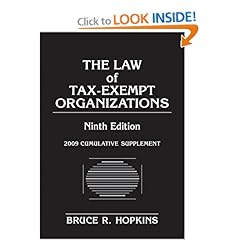
Review of The Law of Tax-Exempt Organizations, 2009 Cumulative Supplement (Paperback)

The nonprofit sector is a huge part of the American economy. Nonprofits range from multinationals to your local little league. While, technically, the same body of tax laws applies to all of them, the level of sophistication varies as dramatically as the size of the nonprofit. And while the big nonprofits can afford to buy expertise, smaller nonprofits have to manage more of the tasks themselves. This book can help.

Hopkins' book is an excellent reference for attorneys and accounts and nonprofit executives with some knowledge of nonprofit tax laws work. It's not likely to be useful to and it's not written for the average volunteer. This is a fairly technical resource, and while nonprofit tax law gets a lot more complicated than Hopkins, this is a very good middle-level resource.

If I have any criticism of Hopkins it's this: in recent editions he has removed important subjects from this reference and spun them off into separate books at equally high prices. Most of the treatment of charitable donations, for example, is now in a different book. Private foundations are now in a different book. Excess benefits transactions are in a different book. You can spend a ton of money on Professor Hopkins. It costs him one star in my rating.

Even so, as a basic entry point, this book is indispensable. I've attended seminars by Prof. Hopkins and read most his books, and he is very knowledgeable and does a good job at the difficult task of translating IRS-speak into comprehensible language. This book should be a part of every nonprofit lawyer and accountant's library.

Product Description
Nonprofit organizations are subject to a complex set of regulations and laws. Written in plain English, this book keeps tax-exempt organizations up-to-date on all current regulations pertaining to tax-exempt organizations. It ensures professionals are well-prepared to make decisions about their organizations? actions and future. It is a definitive one-volume source of information on federal laws by the leading legal authority in the nonprofit sector. This guide is supplemented annually to keep the lawyers and managers of nonprofit organizations on top of the latest nonprofit legal and tax developments.

About the Author
Bruce R.Hopkins is the country's leading authority on tax-exempt organizations and is a lawyer with the firm Polsinelli, Shalton, Welte, P.C. He is also the author of nineteen books, including The Legal Answer Book for Private Foundations, The Legal Answer Book for Nonprofit Organizations; The Law of Tax-Exempt Organizations, 8E; Private Foundations: Tax Law and Compliance, 2E; A Legal Guide to Starting and Managing a Nonprofit Organization, 4E; and The Tax Law of Charitable Giving, 3E, as well as the newsletter Bruce Hopkins' Nonprofit Counsel, all published by Wiley.--This text refers to the Hardcover edition.

Click Here to see more reviews about: The Law of Tax-Exempt Organizations, 2009 Cumulative Supplement (Paperback)